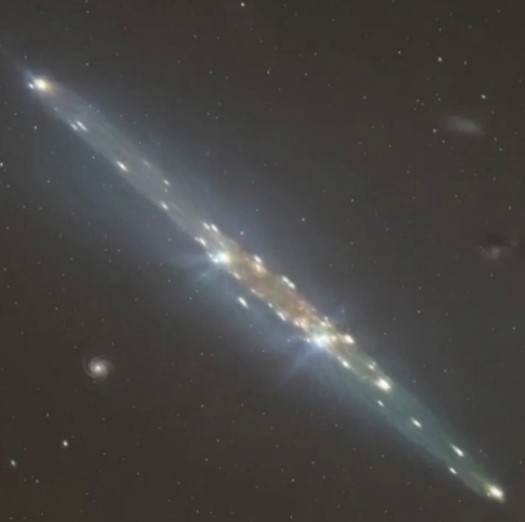
A peculiar interstellar visitor, 3I/ATLAS, is challenging conventional comet science with its unusual behavior and composition. Observed traveling on a hyperbolic trajectory at roughly 57 km/s, it cannot be bound by the Sun’s gravity, confirming it came from outside our Solar System. Its nucleus measures between 0.44 km and 5.6 km, making it comparable in size to many known comets.
The comet displays a sunward tail (anti-tail) at around 4 AU from the Sun, initially pointing toward the Sun rather than away. Models suggest this can occur naturally if CO₂ sublimation releases water-ice grains on the sunlit side, which later evolve into a conventional antisolar tail as the comet approaches perihelion.
Spectroscopy shows unusual composition, including high CO₂ levels and elevated nickel content with low iron—rare for comets, but not impossible naturally. Some scientists, including Avi Loeb, have speculated on non-natural origins as a thought experiment, though no evidence currently supports an artificial source.
3I/ATLAS provides a unique opportunity to study interstellar chemistry, comet physics, and planetary system diversity, and continued observations will clarify its behavior, tail evolution, and any non-gravitational effects.
Leave a Reply