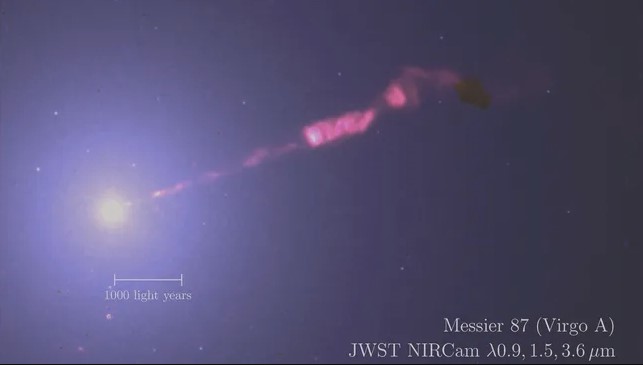
The James Webb Space Telescope (JWST) has captured unprecedented images of the powerful jets blasting from the supermassive black hole at the center of the galaxy Messier 87 (M87*), located 54 million light-years from Earth. The images, published on September 22 in Astronomy & Astrophysics, offer the clearest views yet of both the main relativistic jet and its massive counter-jet — features that have long intrigued astronomers.
M87* is already famous as the first black hole to be directly imaged by the Event Horizon Telescope in 2019. It has a mass around 6.5 billion times that of our Sun, and it lies at the heart of one of the largest galaxies in the Virgo Cluster. The black hole’s jets — composed of subatomic particles — are hurtling through space at nearly the speed of light.
Previous observations using the Very Large Array (VLA) showed the main jet forming a double-helix structure stretching roughly 8,000 light-years. JWST’s new infrared imaging, however, has revealed fine structural details and a clearer view of the counter-jet that had remained elusive until now.
“This makes M87* an ideal laboratory to study jet physics,” said study co-author Jan Röder, noting the black hole’s proximity and brightness across the electromagnetic spectrum.


Leave a Reply