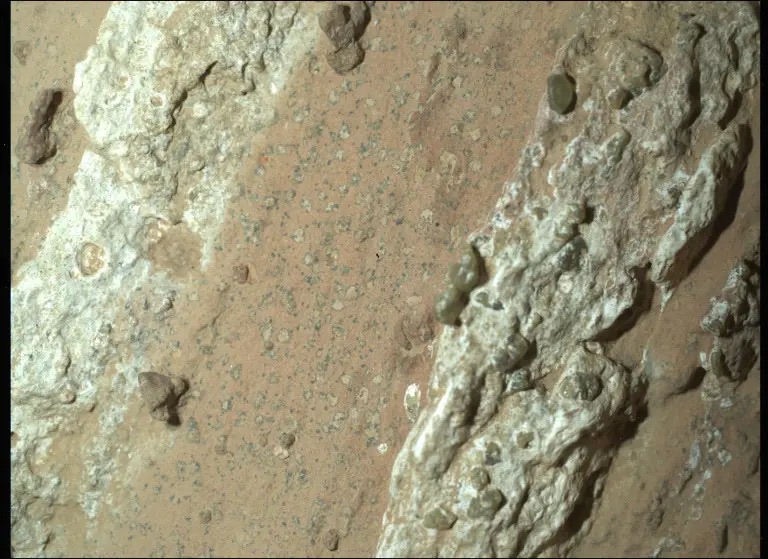
NASA’s Perseverance rover has uncovered compelling evidence that could hint at ancient microbial life on Mars. A sample collected last year from a rock dubbed “Cheyava Falls”, located in the dry riverbed of Jezero Crater, shows possible biosignatures, based on a study published in Nature.
The rock sample, known as “Sapphire Canyon”, lies within the Bright Angel formation of the Neretva Vallis river valley. The region’s sedimentary clay and silt are rich in organic carbon, sulfur, oxidized iron (rust), and phosphorus—materials that on Earth can preserve ancient life and serve as energy sources for microbes.
In high-resolution images, scientists observed “leopard spots”—distinct mineral patches made of vivianite (hydrated iron phosphate) and greigite (iron sulfide). These minerals form under certain chemical conditions and may signal microbe-driven reactions, though non-biological explanations remain possible.
NASA emphasizes that while the findings are groundbreaking, they are not confirmation of life. Further analysis is required to rule out purely chemical processes. This discovery suggests Mars may have been habitable longer than previously assumed, and that relatively younger rocks might yet harbor traces of life.


Leave a Reply