US gas prices cross $4 a gallon for first time since 2022 as Iran war squeezes oil supply

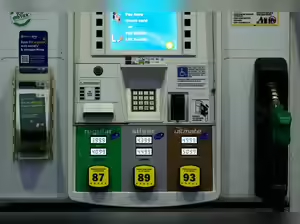
New York — US gas prices crossed $4 a gallon on Tuesday for the first time in nearly four years. Motor club AAA put the national average for a gallon of regular gasoline at $4.02, a figure that marks a threshold American drivers have not crossed since 2022, when Russia’s invasion of Ukraine sent energy markets into turmoil. Since the US and Israel launched strikes on Iran on February 28, gas prices have climbed by more than a dollar a gallon at the national level.

The $4.02 figure is a national average. Drivers in states such as California, Washington, and parts of the Northeast have been paying well above $4 a gallon for several weeks. The national figure crossing the threshold signals that the cost burden has now spread beyond those markets to the country as a whole.

The Iran war has cut supply chains across the Middle East and driven crude oil — the primary input for gasoline production — into rapid price swings. Iran’s closure of the Strait of Hormuz, a waterway that carries roughly one-fifth of global oil flows, sits at the centre of the disruption. With the strait blocked, producers across the Gulf have struggled to move oil to market, tightening supply and pushing benchmark prices higher. WTI Crude settled above $100 per barrel on Monday for the first time since July 2022.

Higher fuel costs ripple through the economy in ways that extend beyond the pump. Businesses that depend on road transport, logistics, and shipping pass rising fuel costs on to consumers through higher prices. Airlines have raised fees to cover jet fuel costs. Households that spend a larger share of income on necessities such as gas and groceries face the sharpest squeeze.

With the April 6 deadline for a US-Iran deal now less than a week away and the Strait of Hormuz still closed, analysts see no near-term relief for fuel prices. If diplomatic talks collapse and the conflict continues past the deadline, markets expect crude to push further above $100 a barrel and gas prices to climb with it.

For more news and update, click here to download our mobile app – Veritas Daily

To explore advertising or sponsorship collaborations, click here to contact us
Iran War Pushes India to Hike Premium Petrol Prices

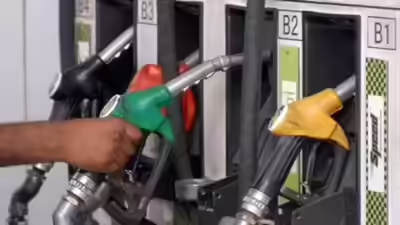
Oil marketing companies in India raised prices of premium petrol by up to ₹2.35 per litre with effect from March 20, as the Middle East conflict disrupted global energy supplies and pushed crude oil prices above $100 per barrel. The government confirmed the hike applies only to premium variants and does not affect regular petrol or diesel.

What Changed at the Pump

BPCL’s Speed, HPCL’s Power, and IOCL’s XP95 saw price increases ranging from ₹2.09 to ₹2.35 per litre. HPCL management sent a message to petrol pump owners directing them to display the revised price of its Power 95 variant from Friday. IOCL’s XP95 is now priced at around ₹101.80 per litre at select outlets.

Regular petrol and diesel prices remain unchanged across major cities including Delhi, Mumbai, Bengaluru, Hyderabad, and Chennai. The government has held these prices steady despite months of volatility in global crude markets, citing inflation concerns.

What the Government Said

Sujata Sharma, Joint Secretary at the Ministry of Petroleum and Natural Gas, confirmed the development at an inter-ministerial press briefing on Friday. “There is no change in normal petrol price, it remains unchanged for the public. Only premium category, it is hardly 2 to 4 percent of entire petrol,” she said.

Sharma added that petrol and diesel prices operate under a deregulated framework, and oil marketing companies take pricing decisions independently. The government positioned the hike as a corporate decision rather than a policy shift.

What Triggered the Global Price Surge

The US-Israeli strikes on Iran on February 28 triggered the conflict that has effectively closed the Strait of Hormuz, through which a fifth of the world’s oil and liquefied natural gas passes. The closure has disrupted supply chains, spiked freight insurance costs, and pushed Brent crude firmly above $100 per barrel.

The latest escalation came when Iran struck Qatar’s Ras Laffan LNG facility — the world’s largest — in retaliation for an Israeli strike on Iran’s South Pars gas field. Brent crude surged 10 percent before pulling back, while European gas prices rose 35 percent in a single session. Iran’s military described the South Pars strike as a “major mistake,” noting the field supplies around 70 percent of Iran’s domestic natural gas.

Why India Feels the Pressure

India imports roughly 85 percent of its crude requirements, with the bulk sourced from the Middle East. Every $10 rise in crude oil prices adds approximately $15 billion to India’s annual import bill. With Brent trading above $110 in recent sessions, the fiscal pressure on oil marketing companies has mounted.

The rupee has also fallen to record lows against the US dollar, making crude imports more expensive. The combination of high crude prices and currency depreciation has squeezed margins at BPCL, HPCL, and IOCL, pushing them toward a price revision.

Why Only Premium Fuel Took the Hit

Oil marketing companies opted to raise prices on premium variants rather than regular fuel. Since premium petrol accounts for only 2 to 4 percent of total consumption, companies can adjust those prices without triggering a broad inflationary impact on the public.

Regular petrol and diesel serve a far larger consumer base and carry greater sensitivity to inflation. Policymakers have held those prices steady to avoid adding pressure to households already absorbing rising food and energy costs.

What Consumers Should Watch

For most consumers, the immediate impact remains limited. Users of high-octane variants such as XP95 and Power petrol will see a marginal rise in fuel expenses, but the change does not affect the bulk of daily commuters and transport operators who use regular petrol and diesel.

However, analysts warn the hike signals that cost pressures have begun to enter the fuel system. If crude oil prices remain at current levels or rise further as the conflict continues, oil marketing companies may find it difficult to hold regular petrol and diesel prices at their current levels. A broader revision, while not confirmed, cannot be ruled out.

For more news and update, click here to download our mobile app – Veritas Daily

To explore advertising or sponsorship collaborations, click here to contact us

Israel Claims Iran’s Security Chief Ali Larijani Killed; Tehran Yet to Confirm

Israeli Defence Minister Israel Katz announced Tuesday that Ali Larijani, one of Iran’s most senior security officials, was killed in overnight strikes carried out by the Israeli military across Iran. Tehran has not confirmed the claim.

Israeli military officials told Reuters that Larijani was among the intended targets of Monday night’s strikes. Iran’s state media, however, pushed back on the reports, stating that a message from Larijani would be published shortly. As of the time of writing, neither the IDF nor any Iranian official has issued a definitive confirmation of his death.

Adding to the uncertainty, a post from Larijani’s official handle at 15:10 IST surfaced after the strike claims, reading:
“On the occasion of the funeral ceremony of the warriors of the Islamic Republic of Iran Navy: Their memory will always be in the hearts of the Iranian nation, and these martyrdoms will establish the foundation of the Islamic Republic Army in the structure of the armed forces for many years. I ask God Almighty to grant these dear martyrs the highest ranks.”

In a separately confirmed development, the Israel Defence Forces said Basij paramilitary force commander Gholamreza Soleimani was killed while at a tent camp — a temporary setup that the Basij had established after Israeli strikes previously destroyed their headquarters. The IDF also confirmed the deaths of Basij’s deputy commander and several other senior paramilitary officials in the same wave of strikes.

Larijani was last seen publicly on Friday in Tehran, attending the Quds Day rallies. That same day, the United States announced bounties of up to $10 million for information on ten Iranian intelligence and military figures, with Larijani named among them.

Larijani has been one of Iran’s most prominent political and security figures for decades, previously serving as Speaker of the Iranian Parliament and later as a senior adviser to the Supreme Leader. His reported death, if verified, would mark a significant development in the ongoing conflict between Israel and Iran.

For more news and update, click here to download our mobile app – Veritas Daily

To explore advertising or sponsorship collaborations, click here to contact us
Trump Seeks to Delay Beijing Visit Amid Ongoing Iran War

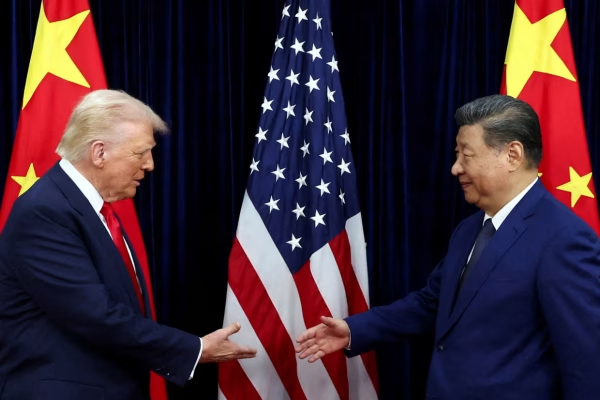
President Donald Trump has requested to push back his planned trip to Beijing by roughly a month, citing the ongoing US-Israeli war with Iran as his reason for wanting to stay close to Washington. The summit with Chinese President Xi Jinping had been scheduled for March 31 through April 2.

“Because of the war I want to be here, I have to be here, I feel,” Trump told reporters at the White House. “And so, we’ve requested that we delay it a month or so.”

The delay comes at a complicated moment. Trump had, at one point, suggested he might scrap the visit entirely. This was contingent on China’s willingness to assist in reopening the Strait of Hormuz.

Iran essentially shut down one of the world’s most critical shipping lanes in direct response to the US-Israeli strikes that took the life of Supreme Leader Ali Khamenei. The consequences have been staggering — the global oil supply took a hit unlike anything seen before, and energy prices around the world have been climbing painfully ever since.

Beijing, for its part, has neither confirmed the summit nor directly addressed Trump’s calls for Chinese naval assistance in the strait. China’s foreign ministry has called for a ceasefire and said it remains in communication with all relevant parties to reduce tensions.

In a subsequent development, China said it has taken note of clarifications issued by the United States regarding reports on the delay. Chinese Foreign Ministry spokesperson Lin Jian stated during a briefing that the US has clarified media reports linking the delay to the issue of navigation in the Strait of Hormuz are incorrect. He said the visit is not related to the situation in the strait.

Treasury Secretary Scott Bessent pushed back on the narrative that the delay was tied to China’s refusal to cooperate, insisting any rescheduling would purely be a matter of logistics.

Analysts suggest both sides may quietly welcome the breathing room, as neither appeared close to finalizing meaningful agreements ahead of the original dates. When the two leaders do eventually meet, trade, Taiwan, and semiconductor access are expected to dominate the agenda.

For more news and update, click here to download our mobile app – Veritas Daily

To explore advertising or sponsorship collaborations, click here to contact us

Powered by WordPress.com.

Up ↑