
PMF Member Killed in Strike on Anbar Headquarters

A member of Iraq’s Popular Mobilisation Forces has died following a US-Israeli strike on the 45th Brigade headquarters of the paramilitary group in Anbar province, western Iraq. The PMF confirmed the fatality as strikes on Iran-aligned groups inside Iraq continue to escalate alongside the broader war on Iran.

The PMF is a state-sponsored umbrella organisation of mostly Shia paramilitary factions that Iraq formally integrated into its security forces in 2016. Several of its brigades maintain close operational and ideological ties to Iran, making the group a recurring target of US-Israeli strikes as the conflict spreads beyond Iranian borders and pulls Iraq deeper into the war.

Anbar province has seen repeated strikes on PMF positions throughout the 38-day conflict. Earlier attacks on the group’s headquarters in the province killed dozens of fighters, including senior commanders, and drew strong condemnation from Iraq’s government. Baghdad described those strikes as violations of national sovereignty and a blatant breach of international law, summoning the US charge d’affaires and filing formal complaints with the United Nations Security Council and other international bodies.

Iraq’s Prime Minister has also granted the PMF a right to respond to any attack against it, a position Baghdad continues to hold. The latest fatality adds to a toll that runs into the dozens across multiple provinces, with the conflict showing no sign of ending as Trump’s Tuesday deadline for Iran to reopen the Strait of Hormuz draws to a close.

For more news and update, click here to download our mobile app – Veritas Daily

To explore advertising or sponsorship collaborations, click here to contact us
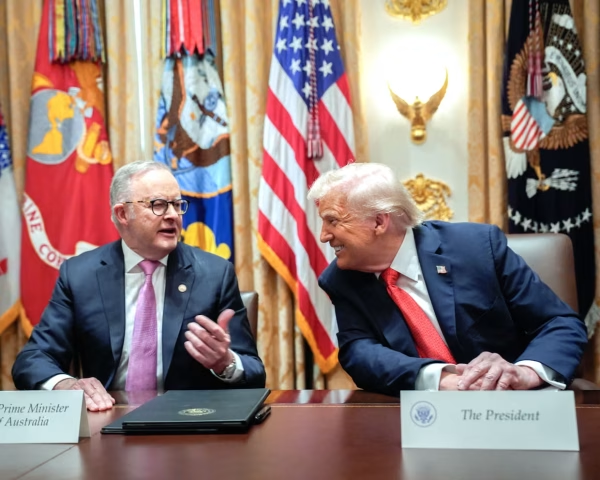
Albanese Presses Trump to Spell Out U.S. Military Goals in Iran Conflict

Australian Prime Minister Anthony Albanese publicly called on U.S. President Donald Trump on Monday to clarify what the United States seeks to achieve through its military involvement in the Iran conflict, signalling unease among Washington’s allies over the direction and aims of the war.

Speaking in Canberra, Albanese said he wants greater certainty on U.S. objectives and stressed the importance of understanding the endgame of the intervention. His remarks reflect concern that Washington has not communicated a clear strategic outcome to its partners as the conflict expands and produces consequences that reach beyond the Middle East.

Australia faces rising fuel prices as the disruption to oil flow through the Strait of Hormuz drives Brent crude above $115 per barrel. The economic pressure the conflict generates has added urgency to Canberra’s desire for clarity on how long the war continues and what conditions would bring it to a close.

Albanese’s statement positions Australia among a group of U.S. allies that support Washington’s broader posture but seek greater transparency on where the conflict leads. His remarks come as diplomatic efforts in Islamabad involving Saudi Arabia, Turkey, Egypt and Pakistan push for de-escalation, while Trump sends signals that combine threats of escalation with openness to a negotiated settlement.

The call for clarification underlines a gap between Washington’s stated objectives and what allied governments understand those objectives to be, a gap that grows as the conflict enters its second month with no resolution in sight.

For more news and update, click here to download our mobile app – Veritas Daily

To explore advertising or sponsorship collaborations, click here to contact us

Iran, U.S. and Israel Trade Strikes as War Engulfs the Middle East

Iran struck a U.S. military base in Iraq on Monday as the conflict between Tehran, Washington and Israel expanded across the Middle East, drawing in multiple fronts and pushing the U.S. troop presence in the region above 50,000.

Iranian forces targeted the U.S. base in Iraq in what officials described as retaliation for U.S. and Israeli strikes on Iranian territory. Separately, a U.S. radar aircraft sustained damage in Saudi Arabia, raising the threat level for American assets stationed across the Gulf. The Pentagon confirmed both incidents and said it monitors the situation.

U.S. and Israeli forces carried out strikes on multiple sites inside Iran, with Israeli jets targeting cities and infrastructure across the country. Iranian forces launched counter strikes in response, hitting cities and drawing condemnation from Western governments. The exchange marks one of the most direct military confrontations between Iran and Israel to date.

Yemen’s Houthi movement struck targets in southern Israel, continuing a pattern of long-range missile and drone attacks the group has sustained since the conflict began on February 28, 2026. Strikes also hit Lebanon, where the UN earlier confirmed the death of a peacekeeper.

The New York Times reported that U.S. troop numbers in the Middle East crossed 50,000, with forces stationed across Saudi Arabia, Qatar, Bahrain and Kuwait. The figure sits roughly 10,000 above the level Washington maintains in the region under normal conditions. An additional 3,500 troops arrived in the region, further reinforcing the U.S. posture as diplomatic efforts to reach a negotiated settlement with Tehran continue in parallel.

For more news and update, click here to download our mobile app – Veritas Daily

To explore advertising or sponsorship collaborations, click here to contact us
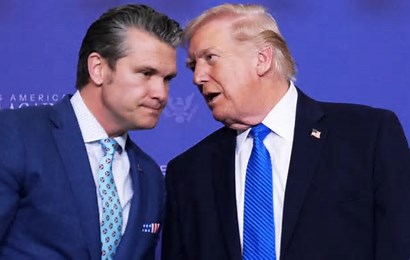
Trump Points to Hegseth as the First to Push for Military Action Against Iran

U.S. President Donald Trump has shifted responsibility for the decision to launch military action against Iran toward Defense Secretary Pete Hegseth, stating that Hegseth was the first official to advocate for the strikes during internal discussions.

Trump made the remarks during a roundtable in Tennessee, with Hegseth seated beside him.

“Pete, I think you were the first one to speak up, and you said, ‘Let’s do it’ because you can’t let them have a nuclear weapon,” Trump said, addressing Hegseth directly.

Trump said he consulted a range of officials before making the decision, naming Hegseth and General Kane among those he called. He described the choice as one between allowing the situation in the Middle East to continue or acting to eliminate what he called a problem.

“I called Pete. I called General Kane. I called a lot of our great people. We got a problem in the Middle East, or we can take a stop and make a little journey into the Middle East and eliminate a big problem,” Trump said.

Trump also revealed that Vice President JD Vance did not strongly support the military action, though Vance did not publicly voice opposition at the time.

The remarks come as Trump has offered different explanations for launching the war. He has at times said the strikes aimed to prevent Iran from producing nuclear weapons, and at other times described the action as a preemptive move to avoid broader regional conflict. Trump also confirmed that he and his officials did not anticipate Iran’s retaliatory strikes on Gulf countries.

The conflict began on February 28 when the U.S. and Israel launched airstrikes on Iran, killing several top officials including Supreme Leader Ayatollah Ali Khamenei. Iran responded with strikes on Gulf nations and moved to effectively block the Strait of Hormuz.

On Monday, Trump announced a five-day pause on all military strikes against Iranian power plants and energy infrastructure, stating that the decision followed productive conversations with Iran over the past two days.

“I am pleased to report that the United States of America and the country of Iran have had, over the last two days, very good and productive conversations regarding a complete and total resolution of our hostilities in the Middle East,” Trump posted on Truth Social.

He added that the pause remains contingent on the continued progress of discussions aimed at a complete and total resolution of hostilities.

For more news and update, click here to download our mobile app – Veritas Daily

To explore advertising or sponsorship collaborations, click here to contact us
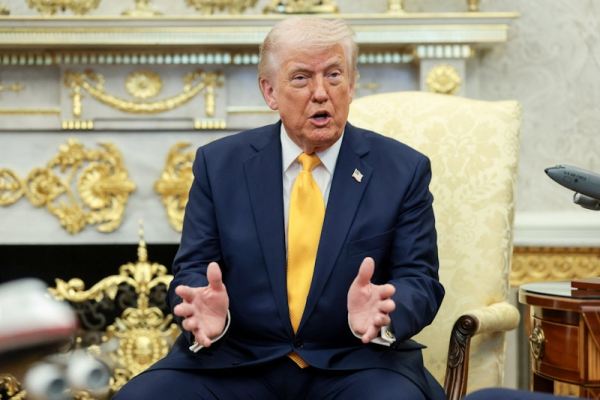
Trump Draws a Line After Israel Hits Iran’s Gas Fields

President Donald Trump warned Israel to halt strikes on Iranian natural gas infrastructure after tit-for-tat attacks between Israel and Iran escalated the war across the Middle East.

Netanyahu confirmed that Israel acted alone in its Wednesday bombing of Iran’s South Pars gas field. He also confirmed that Trump asked Israel to hold off on further attacks of this nature.

Iran retaliated by striking Qatar’s Ras Laffan Industrial City — the world’s largest gas plant — causing damage that analysts say will take up to five years to repair. The plant processes around one-fifth of the world’s liquefied natural gas. The attack sent energy prices jumping across markets.

Iran also targeted a refinery in Saudi Arabia and forced the United Arab Emirates to shut gas facilities. Investors sold assets globally, including government bonds, stocks, and gold, as markets faced fears of wider dislocation.

The Trump administration requested $200 billion in additional funding for the war, but faces opposition in Congress, which must approve the funds. Trump met Japanese Prime Minister Sanae Takaichi at the White House and pressed her to “step up” support.

Seven nations — Britain, Canada, France, Germany, Italy, the Netherlands, and Japan — issued a joint statement expressing readiness to ensure safe passage through the Strait of Hormuz.

Foreign ministers from 12 Arab and Islamic states, meeting in Riyadh, called on Iran to immediately halt its attacks and respect international law.

For more news and update, click here to download our mobile app – Veritas Daily

To explore advertising or sponsorship collaborations, click here to contact us

Powered by WordPress.com.

Up ↑