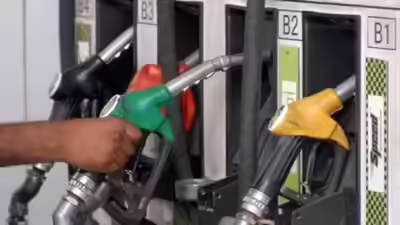
Oil marketing companies in India raised prices of premium petrol by up to ₹2.35 per litre with effect from March 20, as the Middle East conflict disrupted global energy supplies and pushed crude oil prices above $100 per barrel. The government confirmed the hike applies only to premium variants and does not affect regular petrol or diesel.
What Changed at the Pump
BPCL’s Speed, HPCL’s Power, and IOCL’s XP95 saw price increases ranging from ₹2.09 to ₹2.35 per litre. HPCL management sent a message to petrol pump owners directing them to display the revised price of its Power 95 variant from Friday. IOCL’s XP95 is now priced at around ₹101.80 per litre at select outlets.
Regular petrol and diesel prices remain unchanged across major cities including Delhi, Mumbai, Bengaluru, Hyderabad, and Chennai. The government has held these prices steady despite months of volatility in global crude markets, citing inflation concerns.
What the Government Said
Sujata Sharma, Joint Secretary at the Ministry of Petroleum and Natural Gas, confirmed the development at an inter-ministerial press briefing on Friday. “There is no change in normal petrol price, it remains unchanged for the public. Only premium category, it is hardly 2 to 4 percent of entire petrol,” she said.
Sharma added that petrol and diesel prices operate under a deregulated framework, and oil marketing companies take pricing decisions independently. The government positioned the hike as a corporate decision rather than a policy shift.
What Triggered the Global Price Surge
The US-Israeli strikes on Iran on February 28 triggered the conflict that has effectively closed the Strait of Hormuz, through which a fifth of the world’s oil and liquefied natural gas passes. The closure has disrupted supply chains, spiked freight insurance costs, and pushed Brent crude firmly above $100 per barrel.
The latest escalation came when Iran struck Qatar’s Ras Laffan LNG facility — the world’s largest — in retaliation for an Israeli strike on Iran’s South Pars gas field. Brent crude surged 10 percent before pulling back, while European gas prices rose 35 percent in a single session. Iran’s military described the South Pars strike as a “major mistake,” noting the field supplies around 70 percent of Iran’s domestic natural gas.
Why India Feels the Pressure
India imports roughly 85 percent of its crude requirements, with the bulk sourced from the Middle East. Every $10 rise in crude oil prices adds approximately $15 billion to India’s annual import bill. With Brent trading above $110 in recent sessions, the fiscal pressure on oil marketing companies has mounted.
The rupee has also fallen to record lows against the US dollar, making crude imports more expensive. The combination of high crude prices and currency depreciation has squeezed margins at BPCL, HPCL, and IOCL, pushing them toward a price revision.
Why Only Premium Fuel Took the Hit
Oil marketing companies opted to raise prices on premium variants rather than regular fuel. Since premium petrol accounts for only 2 to 4 percent of total consumption, companies can adjust those prices without triggering a broad inflationary impact on the public.
Regular petrol and diesel serve a far larger consumer base and carry greater sensitivity to inflation. Policymakers have held those prices steady to avoid adding pressure to households already absorbing rising food and energy costs.
What Consumers Should Watch
For most consumers, the immediate impact remains limited. Users of high-octane variants such as XP95 and Power petrol will see a marginal rise in fuel expenses, but the change does not affect the bulk of daily commuters and transport operators who use regular petrol and diesel.
However, analysts warn the hike signals that cost pressures have begun to enter the fuel system. If crude oil prices remain at current levels or rise further as the conflict continues, oil marketing companies may find it difficult to hold regular petrol and diesel prices at their current levels. A broader revision, while not confirmed, cannot be ruled out.
For more news and update, click here to download our mobile app – Veritas Daily
To explore advertising or sponsorship collaborations, click here to contact us
